Ojonugwa Joana Achoba


Trade in flow enhancements for The Mobile Shop
The trade in tool is an integral tool for customers to check their phones worth in preparation for an upgrade.
How do we improve the trade-in journey to reduce drop-offs which leads to low conversion rate and ultimately affects sales?
Project Background
The trade-in flow is experiencing significant drop-offs after Step 1, with only 25% of users progressing further. This low conversion rate impacts the effectiveness of direct and indirect trade-in campaigns that drive traffic to the tool. Since trade-in is integral to the customer journey, these drop-offs risk losing potential reserves and, ultimately, sales.
Goal
Help users find their device and estimate its value easily.
Encourage reserving their new phone online to expedite the trade-in process in stores.
Content Design Process
Competitive Research
The Product Designer and I looked at competitors to understand how their Trade-in flow looked and discovered the following:
Research Findings
Best Buy: Offers quotes for various device types. Users can search by phone brand rather than manufacturer.
Virgin Mobile: Features an "online quote" tool that allows quick searches by device name (with an autocomplete dropdown) and carrier, or by manufacturer, model, and carrier.
Telus: Provides an online trade-in tool where users can input their device name to estimate its value.
Rogers: Includes an online quote tool with options to search visually by device or by brand and model.
Bell: Offers an online quote tool that enables users to search by device or by manufacturer and model.

An image showing research board with screenshots of what competitors trade in flow looks like.
Audit of Existing Design

An image showing what trade in flow looked like before improvement.
Potential Reasons for Drop-Off
Drop-offs may be occurring due to the following challenges:
The IMEI search function is not working properly, resulting in devices not being found.
Users are unable to locate their IMEI number.
User errors when inputting the IMEI number, especially on mobile, as there is no option to copy and paste it.
Proposed Improvements
Remove the IMEI requirement: This outdated data is not used by competitors such as Bell, Virgin Mobile, Telus, Rogers, Best Buy, Samsung, or Apple.
Eliminate the carrier field: Carrier information is not necessary to estimate a phone's value.
Provide alternative phone lookup options: Allow users to search by device description (quick search) or by brand and model. This also improves accessibility for users relying on screen readers.
Add a tooltip: Offer additional guidance for users who need help finding their device information.
Outline the trade-in journey upfront: Display the steps of the trade-in process at the top of the page to help users understand what to expect and improve engagement.
An image showing what 'next steps' looked like before improvement
Areas for Improvement
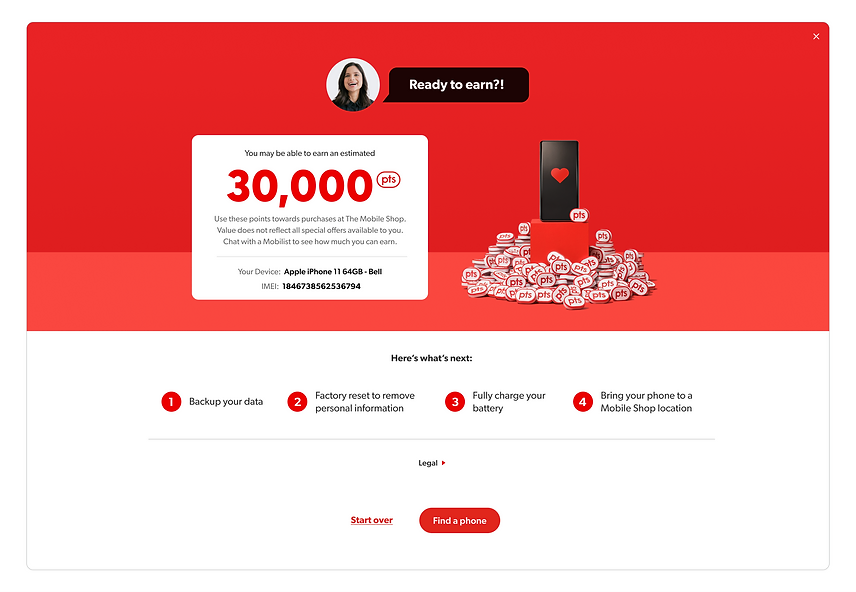
The current next steps may give users the impression they can trade in an old phone without purchasing a new one. Additionally, the steps do not align with the new reserve process.
The "Find a Phone" CTA currently redirects users to the MSA (phone finder) flow, which could be improved by reducing the number of questions and enhancing the confirmation screen.
Proposed Improvement
Update next steps message: Clearly outline the next steps to encourage users to reserve their next phone online, prepare their current phone for trade in, and reduce in-store wait times during pick-up.
Revise the "Find a Phone" CTA: Repurpose it to anchor users to the phones listing page when clicked, creating a more intuitive navigation experience.
Tone and Voice Used
I focused on creating content that is helpful, clear, and concise to ensure users feel confident in their decisions and understand the next steps to take.
What I Did
I adopted a guidance-focused approach to the copy, providing clear explanations at every step of the trade-in experience.
I crafted engaging headlines, such as "Turn your old phone into points for your next upgrade," to capture user attention.
I simplified language by replacing ambiguous terms (e.g., changing "Mobile Device" to "Phone") for better clarity.
Updated the end-of-journey copy to outline the next steps, encouraging users to make online reservations.
I also emphasized reduced wait times in the copy to drive online reservation behavior.
Additionally, I repurposed the "Find a Phone" CTA to guide users directly to the phone listing page, improving navigation.
Image of what updated designs look on mobile device


Design / Copy Testing
Copy was tested to see if users clearly understood the trade in flow and whether the information on next steps was sufficient to help them make informed decisions.
All participants loved how the header highlighted value of their old phones .
Users appreciated how clear detailed the trade in flow was and how next steps helped them prepare better for what to expect next.
Stakeholder Review/Management
Review sessions were held with stakeholders across business, marketing, product, and legal to share research findings and explain the copy rationale. Overall, the feedback was positive, and any feedback was taken and reviewed before implementing on design.
Results
|
Next Steps
Continue to monitor the data and funnel conversion for trade-in after implementation to find areas of improvement in both design and content.
Screen record of the trade in flow